Food Devils fight by day: Combat & Cooking Guide
Master Food Devils' combat and restaurant loop with tips for calories, mission objectives, skill builds, cooking, and demo progression.
Your next dinner might be the monster that ends your expedition. The Food Devils fight by day premise matters because every tactical decision feeds into your restaurant, recruitment options, and preparation for the next run. This Food Devils fight by day guide explains how to connect those systems without wasting turns, ingredients, or adventurers.
You play the last chef in a post-apocalyptic world, serving monstrous meals and sending adventurers into danger under Devil Contracts. Success requires more than strong attacks: you need to understand objectives, manage calories, and cook with tomorrow’s expedition in mind.
Version note: This guide uses official announcements available as of October 31, 2026, alongside demo footage labeled below as player experience. Older footage may differ from the current demo.
How the Food Devils Fight by Day Loop Works
Food Devils combines a tactical RPG, roguelite expeditions, and restaurant management. These are connected systems rather than separate activities: expeditions supply ingredients, meals support adventurers, and restaurant customization influences potential recruits.
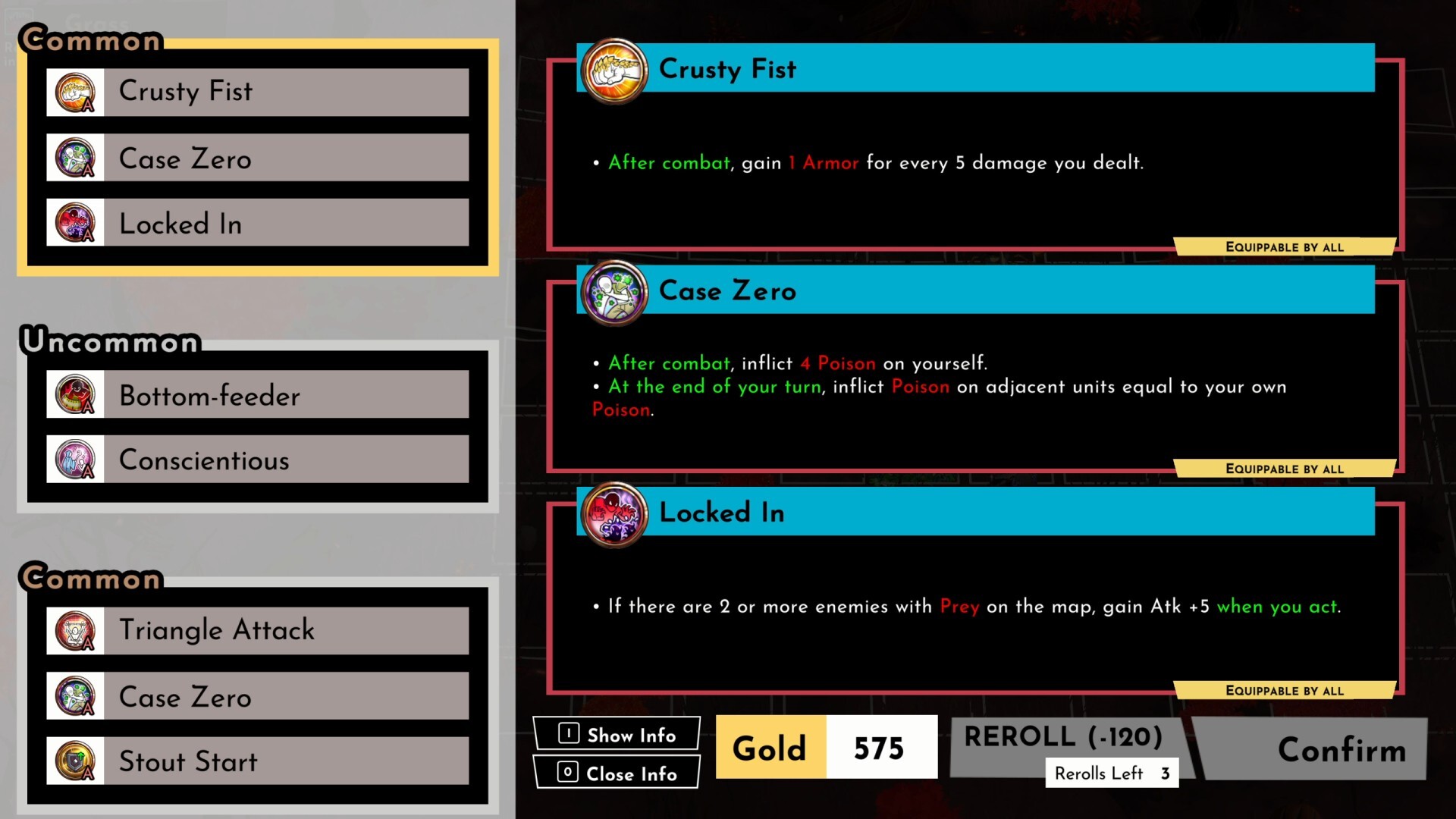
Official screenshot · Source: Steam store
The practical goal is to return with enough useful resources to improve your next attempt—not simply win every optional fight.
| Stage | What you do | What to check |
|---|---|---|
| Prepare | Select your Devil and adventurers | Roles, skills, and contract rules |
| Explore | Choose encounters and events | Rewards versus current party condition |
| Fight | Complete a grid-based objective | Turn limit, positioning, and resources |
| Return | Review expedition results | Recovered ingredients and progression |
| Cook | Choose recipes and ingredients | Nutrition and expedition buffs |
| Recruit | Attract and assess adventurers | Class coverage and build compatibility |
For the Food Devils fight by day loop, think one expedition ahead. Ingredients are valuable because of what you can cook with them, while recruits matter because of how well they fit your available skills and Devil.
What the current demo includes
According to the developer’s official Food Devils Steam announcements, the October demo includes approximately five to six hours of Prologue content, two playable Devils—Hunter and Poison—and full English voice-over.
The developer announced an Early Access launch for November 3, 2026. Saves from the October demo are intended to transfer into Early Access; June demo saves are incompatible with the newer demo.
That distinction matters if you are returning after an earlier trial. Check which version you have before investing time in a fresh build.
Choose Mission Objectives Before Choosing Targets
The fastest way to lose a promising run is to play every encounter like an elimination battle. Food Devils offers different objectives, and their requirements change how you should move, spend resources, and evaluate threats.
Before confirming an encounter, read its objective, advertised rewards, and available enemy information. Once deployed, check the turn limit before taking your first action.
| Objective | Core requirement | Recommended approach | Common mistake |
|---|---|---|---|
| Hunt | Defeat all enemies within the limit, including later spawns | Maintain forward pressure | Leaving a distant enemy until the final turn |
| Defend | Keep the Food Devil alive until the limit ends | Control approaches and protect your Devil | Chasing enemies away from a safe formation |
| Escape | Occupy escape tiles before the limit | Advance while clearing essential obstacles | Spending turns on unnecessary kills |
| Gather | Interact with every gathering spot before time expires | Plan routes and protect access points | Discovering too late that an enemy blocks a required spot |
Official update notes clarify that Defend encounters can end early when every enemy is defeated and no further reinforcements are scheduled.
Escape is a movement problem first
In the supplied player experience, an Escape encounter deteriorated while the party fought near its starting area. Reinforcements accumulated, healing resources dwindled, and the route became harder to navigate.
The lesson is not that Escape is always a poor choice. It is that the objective requires a different plan.
Before moving:
- Identify the escape tiles and read their completion conditions.
- Estimate the route using actual movement costs.
- Mark enemies that genuinely block progress.
- Keep support units close enough to help without trapping the party.
- Avoid assuming that reaching one tile instantly removes a unit from danger.
The Food Devils fight by day strategy that works here is simple: attack to enable the objective, not instead of completing it.
Treat turn limits as a resource
Community reports describe losses caused by overlooked timers, late reinforcements, and blocked gathering interactions. Those accounts are player experiences, not proof that every encounter is unbalanced.
Still, they support a useful habit: review progress after each round. If you have completed little of the objective by the midpoint, stop taking optional fights and reassess your route.
Manage Calories, Hunger, and Positioning Together
Food Devils makes resource management part of combat. Devils require Cal, or calories, to act, and the tutorial shown in the footage explains that they can draw required calories from adventurers according to their governing rules.
A powerful Devil is therefore not automatically a reliable frontline unit. If its available actions depend on resources you have already exhausted, an aggressive position can become a liability.
Read the contract before building around it
Your first preparation task should be understanding the selected Devil’s resource rules.
Check:
- Which actions require calories.
- How the Devil obtains those calories.
- How adventurers’ hunger interacts with the arrangement.
- Which skills provide useful effects under those conditions.
- Whether the party can still function when the Devil cannot use its preferred action.
Do not rely on a strong-looking ability without checking whether you can actually activate it.
| Resource or tool | Why it matters | Practical habit |
|---|---|---|
| Calories | Enable Devil actions | Check costs before moving into danger |
| Hunger | Interacts with adventurer systems and meal preparation | Review it alongside HP |
| Healing charges | Some support abilities have limited uses per map | Avoid spending them on trivial damage |
| Terrain | Can affect damage, recovery, and movement | Inspect tile descriptions before committing |
| Counter settings | Influence possible responses to attacks | Verify the current counter and its requirements |
| Combat preview | Displays expected combat outcomes and additional effects | Read it before confirming risky attacks |
Use terrain without surrendering the objective
The supplied player experience shows terrain that reduces incoming damage, with healing terrain also restoring HP. Some terrain costs additional movement to cross.
That creates a trade-off. A defensive tile can help stabilize a wounded unit, but taking a detour may be disastrous during a timed Escape or Gather encounter.
Inspect the current tooltip rather than memorizing numbers from older footage. Your decision should account for both survival and how much movement the tile consumes.
Never assume a counterattack will happen
The footage includes repeated uncertainty about why units were not retaliating. Treat that as a warning to inspect the mechanics, not evidence that counters are automatic or broken.
Before using a unit to absorb attacks, check its selected counter, relevant conditions, and available resources. When the interaction is unclear, the Training Grounds offer puzzle-like simulations designed to teach specific mechanics.
For Food Devils fight by day beginners, learning one interaction safely is more useful than losing an expedition while guessing.
Build Skills and Choose Events With a Plan
Skill Packs introduce new options during expeditions, but collecting skills is only the first step. The demo tutorial shows that skills must be equipped in matching A, B, or C categories.
After receiving a pack, open the equipment screen and inspect every party member. An appealing skill contributes nothing if it remains unequipped or duplicates a role your party already handles well.
Prioritize useful combinations over pack size
Choose skills by asking what your party currently lacks:
- Survival: Can someone withstand the next enemy phase?
- Movement support: Can allies reach objectives efficiently?
- Damage: Can you remove a dangerous blocker quickly?
- Resource support: Can the build sustain its intended actions?
- Synergy: Do the skill’s conditions match your formation and contract?
In the supplied player experience, adjacency-based bonuses, defensive effects, and movement assistance all presented useful possibilities. Their value depended on positioning and equipment compatibility—not simply how many skills appeared in a pack.
Evaluate the whole event outcome
Events can offer ingredients, gold, or Infernal Codex clauses, but a benefit for the Devil may impose a cost on adventurers.
One event in the player experience produced a clause that helped the Devil while applying harmful effects to human allies. Another unsuccessful event choice removed 30 HP from the Devil.
Those are examples from that run, not universal event outcomes. The broader advice is to read every effect before accepting it.
A useful risk check is:
- What does success provide?
- What can failure cost?
- Can the party absorb that loss before another battle?
- Is there a safe alternative?
The Food Devils fight by day loop rewards experimentation, but an injured party is a poor testing ground for a gamble you do not understand.
Make Your Restaurant Support the Next Expedition
Restaurant customization is more than decoration. The demo explains that furniture and decor influence visiting adventurers, including factors such as their number, rarity, class, and flavor.
Use the current interface descriptions to evaluate each selection. Older footage contains furniture comparisons that should not be treated as definitive: official patch notes specifically mention correcting the Primal set’s adventurer count.
| Preparation goal | What to inspect | Why it helps |
|---|---|---|
| Replace losses | Expected visitor numbers | Provides more recruitment candidates |
| Improve recruit quality | Rarity probabilities | Helps evaluate potential upgrades |
| Fill a missing role | Class-related furniture effects | Supports party balance |
| Support flavor synergy | Kitchen-related effects | Helps target compatible recruits |
| Reduce hunger | Recipe nutrition | Improves expedition preparation |
| Strengthen a build | Recipe’s special buff | Connects cooking to combat strategy |
Cook for a specific need
The cooking tutorial explains that recipes have ingredient requirements, nutrition values, and special buffs. Some accept ingredients from a category; others need particular ingredients. Repeated cooking also levels up a recipe.
Before setting the menu, identify your next expedition’s biggest weakness.
If hunger is a concern, compare nutrition. If survival is the problem, inspect available defensive or recovery benefits. If supplies are limited, check whether a flexible recipe can use ingredients that would otherwise sit unused.
For Food Devils fight by day preparation, a meal that solves a real problem is more valuable than one chosen without checking its effects.
Recover deliberately after a failed run
The supplied player experience shows ingredients and progression appearing in the expedition report after failure, while adventurer deaths create recruitment needs. It does not establish that every resource or skill always persists.
Read the report carefully, then rebuild around what actually remains. Before departing again:
- Replace missing combat and support roles.
- Equip newly available skills.
- Check hunger, meals, and contract interactions.
- Practice unclear mechanics in the Training Grounds.
- Consider disabling extended combat animations if you prefer faster encounters.
Failure becomes useful when it changes your next plan.
FAQ
What is the Food Devils fight by day gameplay loop?
You organize tactical expeditions to obtain monstrous ingredients, return to prepare food, and attract adventurers through your restaurant. Cooking, recruitment, Devil Contracts, and skill choices all contribute to preparation for later runs.
How long is the Food Devils demo?
The developer describes the October demo as approximately five to six hours of Prologue content, with additional replayability through builds and roguelite systems. It includes Hunter and Poison as playable Devils.
Does demo progress transfer to Early Access?
The developer announced that saves from the October demo will be compatible with Early Access. Saves from the earlier June demo are not compatible with the newer demo.
Is Food Devils optimized for Steam Deck?
As of the official October announcement, Food Devils was not yet optimized for Steam Deck. The developer expressed plans to improve optimization around launch or afterward, but that should not be treated as confirmed readiness.
Related Guides
Food Devils base builder: Restaurant Strategy Guide
Learn how Food Devils' restaurant, furniture, cooking, recruitment, and relationships support stronger parties and smarter roguelite expeditions.
Food Devils gameplay: Combat and Restaurant Guide
Learn Food Devils gameplay basics, from tactical combat and Devil Contracts to cooking buffs, restaurant recruitment, and smarter expedition planning.
Food Devils monster hunter: Gameplay Guide
Explore Food Devils’ monster-hunting premise, cooking, devil contracts, and restaurant management—and learn what the trailer actually confirms.
Food Devils romance: Characters and Relationship Guide
Explore Food Devils romance options, character personalities, relationship progression, and what remains unconfirmed before Early Access.
Food Devils demo gameplay: Combat and Cooking Guide
Explore Food Devils demo gameplay, tactical combat, cooking buffs, playable Devils, save transfers, and tips for the 5–6-hour Steam prologue.